
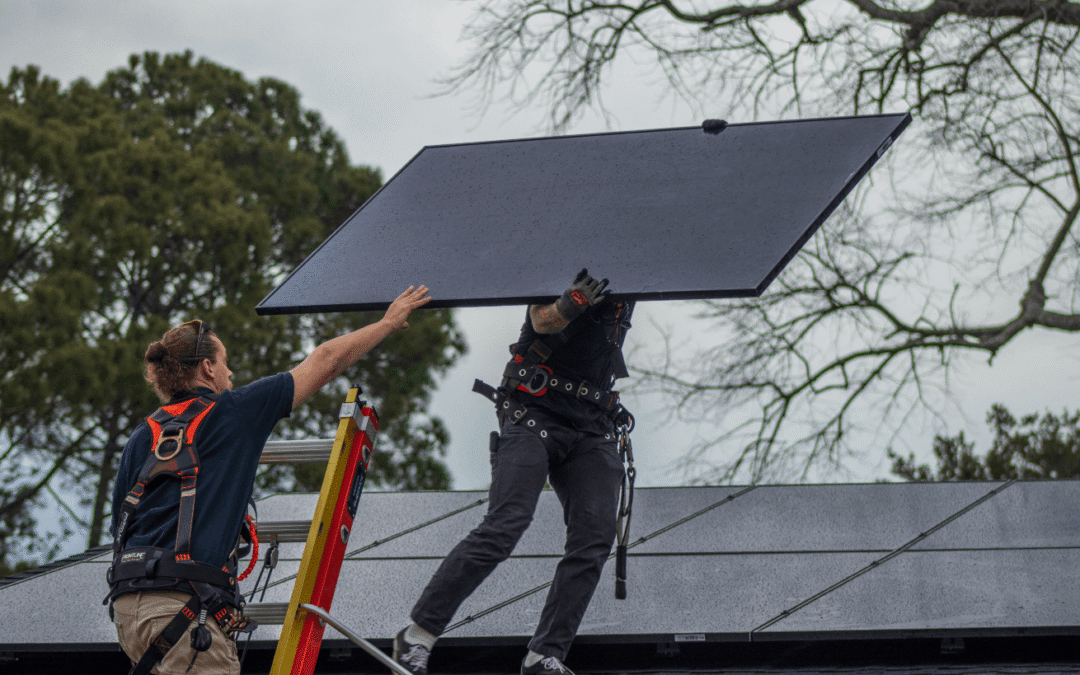
The choice between repairing and replacing a solar panel depends on what is actually damaged. A limited repair may make sense when the problem is external to the module or otherwise correctable without compromising the panel. Replacement becomes more appropriate when the module itself has sustained damage or failure that cannot be restored reliably.
Start With the Location of the Problem
A panel that appears to be underperforming is not necessarily a failed module. A connector, module-level electronic device, or nearby wiring can affect what monitoring reports. That distinction changes the work being considered: repairing a connection is not the same as replacing a solar panel. Before approving a module replacement, the homeowner should understand what evidence points to the panel itself rather than an adjacent component.
| Condition | More Likely Direction |
|---|---|
| Loose or repairable connection associated with the panel | Repair may be possible |
| Correctable wiring issue near the module | Repair may be possible |
| Confirmed module electrical failure | Replacement may be appropriate |
| Significant glass/module damage or compromised integrity | Replacement may be appropriate |
| Unclear low production | Diagnose before choosing either option |
These are decision patterns, not automatic rules. The same visible symptom can have different underlying causes.
When "Panel Repair" Does Not Mean Repairing the Module Itself
Homeowners often use "panel repair" to describe any work at one solar panel position. The actual repair may involve a connector, wire, mounting-related issue, optimizer, microinverter, or another component associated with that module. If the panel itself is electrically and physically sound, replacing it would not address the real problem.
For more information about adjacent components, see our guides to solar optimizers and microinverters, including how failures can affect individual panel positions.
When Replacement Makes More Sense
Replacement becomes more likely when testing confirms that the module itself has failed, physical damage compromises its integrity, or the panel cannot reasonably be returned to reliable operation through a limited repair. The goal is individual component replacement when appropriate, not assuming the whole array must be replaced because one module has a problem.
Compatibility Can Decide the Question on Older Systems
Replacement modules need to fit more than the available roof space. Electrical characteristics, physical dimensions, mounting arrangements, and compatibility with the remaining equipment can affect whether a substitute is suitable. When the original model is discontinued, a replacement may require more research and a different scope than a straightforward like-for-like exchange.
A discontinued panel adds another layer to the decision. A replacement needs to work with the existing system's electrical characteristics and physical configuration. Availability, dimensions, connectors, mounting, and system architecture can all matter. An older array may therefore require compatibility research even when only one module needs replacement.
What the Decision Should Not Be Based On
- Panel age alone
- One low reading in an app
- A visual assumption from the ground
- The fact that the original installer is no longer available
- A desire to replace equipment before the failed component has been confirmed
Repair and Replacement Planning Costs
A lower initial repair price is useful only if the underlying condition can be corrected reliably. If a damaged module cannot be restored safely, repeated minor work is not an equivalent alternative to replacement. Conversely, replacing a functioning module will not resolve a failed optimizer or damaged connection. The diagnosis and the repairability decision should come before the price comparison.
Infinity Solar Solutions estimates minor solar panel repair at $350–$450* and individual solar panel replacement at $550–$650*. Diagnostics are estimated at $350–$500* when the source of the problem has not been confirmed.
The related article "How Much Does It Cost to Replace a Damaged Solar Panel?" owns the detailed cost question. "Broken Solar Panels: Understanding Damage, Performance, and Repair Options" explains what can happen to system production when a module is damaged.
A Practical Decision Sequence
- Confirm that the problem is actually associated with the panel position.
- Determine whether the module itself or an adjacent component is responsible.
- Assess whether the condition can be corrected without replacing the module.
- If replacement is needed, confirm compatible equipment and scope.
- Repair or replace only what the evidence supports.
Three Questions Usually Decide the Direction
First, is the solar module itself damaged, or is the problem actually in nearby wiring, connectors, mounting, or module-level electronics? Second, if the module is damaged, is there a limited repair that can restore safe, dependable operation, or has the module reached a condition where replacement is more appropriate? Third, if replacement is appropriate, can a compatible module be sourced for the existing array? Those questions are more useful than deciding based on age or appearance alone.
Cracked Glass Is Not a One-Answer Problem
A crack can range from superficial-looking damage to a condition that compromises the module's protective layers and long-term reliability. The visible crack alone does not tell a homeowner whether the panel can remain in service. Location, extent, moisture exposure, electrical behavior, and manufacturer guidance can all matter. That is why a cracked panel should be evaluated as a specific condition rather than treated with a universal "repair" or "replace" rule.
Why Older Arrays Can Make Replacement More Complicated
Replacing one module in an older array is not always as simple as buying a panel with similar wattage. Physical dimensions, electrical characteristics, connector compatibility, mounting constraints, and the way the existing string or module-level electronics are configured can affect the replacement choice. A discontinued original module does not automatically mean the entire array must be replaced, but it can make compatibility research part of the repair.
Frequently Asked Questions
Can a cracked solar panel be repaired?
It depends on the nature and extent of the damage. Significant module damage may make replacement more appropriate than attempting to restore the panel itself.
Does one damaged panel mean the entire array needs replacement?
No. A single-panel problem can often be evaluated as an individual component issue.
Is replacing a panel always more expensive than repairing it?
Infinity Solar Solutions' planning ranges are $350–$450* for minor panel repair and $550–$650* for panel replacement, but the actual scope determines final cost.
Pricing Disclaimer
*Pricing is provided for general planning purposes only and is not a quote or guarantee. Actual pricing depends on the specific system, equipment, condition, accessibility, labor, parts availability, warranty coverage, electrical scope, roof conditions, and other project factors. A system evaluation may be required before Infinity Solar Solutions can confirm the appropriate repair or project scope and final price.