
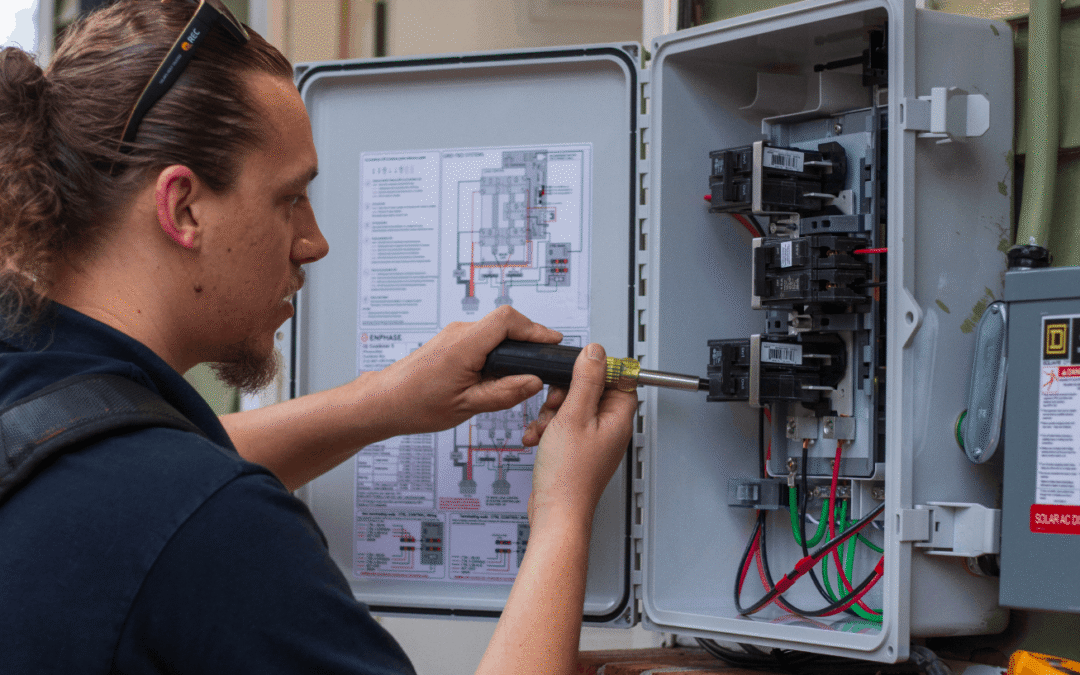
A solar combiner box is electrical equipment used to bring multiple photovoltaic circuits together at a common point before power continues to other system equipment. Its exact design and role depend on the array architecture, so not every residential solar system uses the same type of combiner equipment.
Why Solar Circuits Need a Common Point
Larger or multi-string arrays can have several electrical paths leaving the panels. A combiner provides an organized location where those circuits can be brought together and, depending on the design, protected or monitored before feeding downstream equipment such as an inverter.
What May Be Inside a Combiner Box
The contents vary by manufacturer and system. A combiner can include terminals, overcurrent protection, disconnecting or monitoring components, surge-related equipment, communications hardware, or other electrical devices. Homeowners should not open the enclosure to identify these parts because PV circuits can remain energized in daylight.
Combiner Box vs. Inverter
The combiner box does not perform the inverter's main job. The inverter converts DC electricity to AC. A combiner primarily organizes or combines incoming PV circuits and may provide associated protection or monitoring functions.
What Combiner Problems Can Look Like
Because the combiner sits between parts of the array and downstream equipment, problems can appear as partial production loss, one string not contributing normally, protective-device operation, electrical warnings, communications issues on equipment that incorporates monitoring, or a broader system shutdown depending on the fault.
Why the Symptom Can Be Misleading
A production problem associated with one string does not prove the combiner is defective. The cause may be upstream in the array, within wiring or connectors, at the combiner itself, or farther downstream. Electrical testing is what separates those possibilities.
When a Combiner Box Becomes Part of Diagnostics
Technicians may investigate combiner equipment when fault history or electrical measurements point toward a particular circuit, when protective equipment has operated, when there is visible damage, or when production data suggests one portion of the array is not contributing normally.
For more information about the troubleshooting process, see what a solar diagnostic visit includes and how a system evaluation can help identify the cause before components are replaced.
Combiner Box Repair Cost
Infinity Solar Solutions estimates combiner box repairs at $500–$600* for general planning purposes. The final scope depends on what is actually damaged, accessibility, equipment compatibility, and whether the issue extends into wiring or other components. Diagnostics are estimated at $350–$500* when the fault has not been isolated.
Safety Matters More Than Identifying the Part Yourself
A homeowner can record error messages, production changes, and visible exterior damage from a safe location. Opening a combiner box or testing PV circuits is not an appropriate homeowner troubleshooting step because energized DC conductors may be present.
Why One Combiner Problem Can Affect Several Panels
A combiner box sits at a point where multiple PV circuits come together. Because of that position, a problem inside or associated with the combiner can affect more than one panel without necessarily shutting down every part of the system. The exact production pattern depends on how the array is wired, which circuits are involved, and what protective equipment is present.
What Technicians Are Trying to Determine
When a combiner becomes part of the investigation, the question is not merely whether the box looks old or whether a protective device has tripped. The useful questions are which circuit is affected, why protection operated, whether there is heat or physical damage, and whether the underlying fault is inside the combiner or elsewhere on the connected circuit. Replacing a fuse or resetting protection without finding the cause can leave the original electrical problem unresolved.
Why Combiner Problems Can Be Confused With Inverter Problems
Both conditions can show up as reduced or missing production. If the inverter is receiving incomplete or abnormal DC input because one or more circuits are interrupted upstream, the homeowner may focus on the inverter even though it is reacting to another electrical problem. That is one reason system-level diagnostics matter before a major component is replaced.
Homeowners experiencing reduced output can also read why a solar system may be producing less power to understand how production changes can have several possible causes.
Frequently Asked Questions
Does every residential solar system have a combiner box?
No. System architecture varies, and some equipment combines functions differently.
Can a combiner box cause only part of the array to stop producing?
It can, depending on which circuits or components are affected, but partial production loss can have other causes too.
Is a combiner box the same as a disconnect?
No. They serve different electrical functions, although some equipment can integrate multiple functions into one assembly.
How much does combiner box repair cost?
Infinity Solar Solutions estimates $500–$600* for general planning purposes.
Pricing Disclaimer
*Pricing is provided for general planning purposes only and is not a quote or guarantee. Actual pricing depends on the specific system, equipment, condition, accessibility, labor, parts availability, warranty coverage, electrical scope, roof conditions, and other project factors. A system evaluation may be required before Infinity Solar Solutions can confirm the appropriate repair or project scope and final price.